
Baltimore City Traffic Warrants Explained
Traffic cases in Baltimore City belong to the District Court, District 1, and no separate city traffic court exists. A payable citation hands the recipient a set of official choices. Miss the trial, though, and the court can issue a bench warrant or a contempt order. An unanswered ticket can also bring a license suspension notice. Those two consequences travel on separate tracks. Keep the basics straight, too. A ticket debt alone is not a warrant, and a suspended license alone does not mean one exists. The court record settles the question, and the citation number is the fastest way into it.
Why the Citation Number Is the Best Search Input
The District Court's own traffic guidance spells out the lookup. Read the terms and acknowledge them. Then enter the citation number in the Case Number field, set Case Type to Traffic, and limit the court system to District Court only. That combination returns one case instead of a page of names. A name search still works when the ticket is gone. Enter the last name exactly as the driver's license shows it, add a first and middle name, and use a date of birth to separate similar names in Baltimore City's busy dockets. If a name search returns too many cases, the citation number is the better route for any Baltimore City warrant check.
Note: A citation number is printed on the ticket and is usually the same sequence shown in the court case record, so a photograph of the paper copy is worth keeping.
Checking for a Traffic Warrant
No driving-record product answers a warrant question. The public index is the first look at a Baltimore City traffic case. The District Court clerk confirms the docket. The Traffic Processing Center handles payment and processing questions, and a written records request gets you a copy.
- Open Maryland Judiciary Case Search and accept the terms.
- Enter the citation number in the Case Number field, or search by exact name.
- Set Case Type to Traffic and the court system to District Court only.
- Open the case and read the event history for a failure to appear, a bench warrant, or a payment entry.
- Call the clerk at the District Court location where the case was filed to confirm what the docket shows.
- Call the Traffic Processing Center at 1-800-492-2656 for payment and processing questions.
What Baltimore City Code 71-2 Adds
One local rule changes the timing. Under Baltimore City Code 71-2, a prepayable criminal citation must explain the payment and trial options. Skip both, and the court can issue a bench warrant for arrest or a contempt show-cause order. There is a buffer, though. No bench warrant may issue under that provision until five days after the scheduled trial date in Baltimore City.
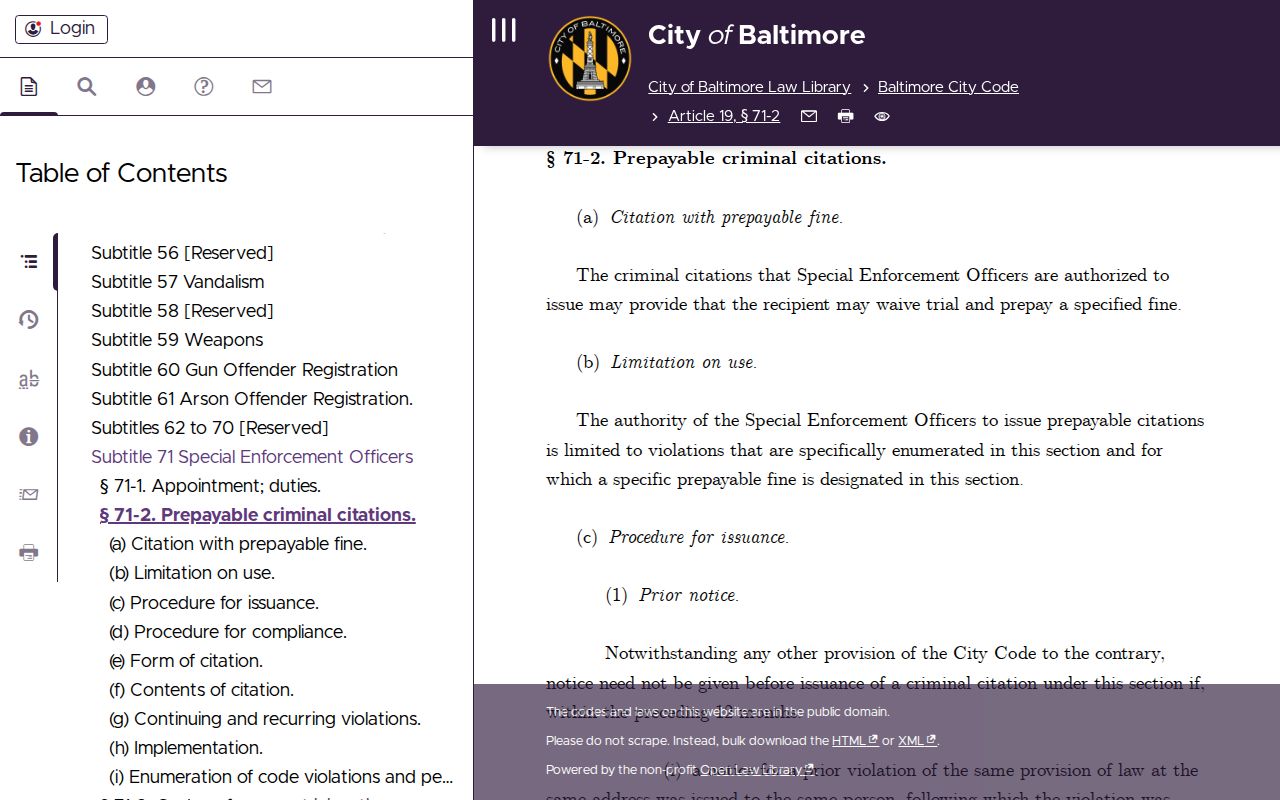
The published code section is where the five-day rule lives. It is one of the few Baltimore City-specific facts in the traffic process, so cite it by section when asking the clerk.
Inside a Traffic Warrant Record
A traffic case record carries citation details, not driving history. What you get is the case and its events. The fields below are the ones that matter for understanding what the Baltimore City court has actually done.
| Citation or Case Number | Used in the Case Number search field and on every later request. |
|---|---|
| Court and Case Type | District Court, District 1, with the case type shown as traffic. |
| Violation and Date | The cited violation and the date it occurred, as the citation records them. |
| Fine and Options | The amount owed and whether the violation was payable or required an appearance. |
| Failure to Appear | A docket entry such as FTA/Bench Warrant when the court records one. |
| Resolution Event | A payment, new date, recall, or disposition entry as the court enters it. |
The Four Official Responses to a Ticket
A payable citation in Baltimore City comes with four official choices. The one a person selects decides what happens next. Want a hearing? Choose it rather than pay.
- Pay the fine, online, by phone, by mail, in person, or at a payment kiosk
- Request a payment plan when the total outstanding is at least $150 and the person qualifies
- Request a waiver hearing to explain the circumstances to a judge
- Request a trial and contest the citation
Do not pay a citation while asking for a trial or a waiver hearing. Payment closes the case in a way that conflicts with the request. The official instructions say to mail the option form to the Baltimore City court instead.
How to Pay or Lift a Traffic Warrant
A still-payable citation leaves the court's options open: pay it, request a payment plan, or set a hearing. Missed a trial date? The next step is a written request to the original court for a new one. If the docket already shows a bench warrant, only the judge can recall it, and the Baltimore City clerk can say what the judge requires. Paying on a warranted case may satisfy the fine. It does not clear the warrant by itself. Ask the clerk whether a recall, a bond, or an appearance comes first, and do that before sending money.
Caution: A bill paid after a bench warrant is issued does not remove the arrest order. Confirm the recall path with the clerk before assuming a payment settles the case.
The Traffic Processing Center and Baltimore Payments
The statewide Traffic Processing Center takes payment and processing questions and accepts mail at a post office box in Annapolis. Call 1-800-492-2656 or 410-260-1093. The center can explain payment options a local counter may not handle. Paying after a court hearing works differently than paying before one. Official guidance says a case decided at a hearing cannot be paid through the automated phone line, the online portal, or a kiosk, and the court directs how it is handled instead. Anyone in that spot in Baltimore City should ask the clerk rather than guess.
Note: A convenience or service fee applies to some payment channels and is not refundable once a payment goes through.
Traffic Warrants, FTA, and License Holds
Three consequences get blended together, but they are not the same thing. Each belongs to a different office, and clearing one does not clear the others in Baltimore City.
| Point | Failure to Appear | Bench Warrant | License Action |
|---|---|---|---|
| What it is | A missed required court event | A judge's arrest order after a missed event | A notice from the Motor Vehicle Administration |
| Who controls it | The court where the case was set | The judge in that court | The state motor vehicle agency |
| How it clears | A new date or a disposition | A recall or service | Compliance information sent by the court |
An unanswered payable ticket can trigger a suspension notice with no bench warrant attached. A missed trial can produce a warrant even when the ticket was already paid. Check both the Baltimore City court record and the notice itself.
Confirming a Cleared Baltimore Traffic Case
A cleared traffic case in Baltimore City needs two confirmations from two different offices. The court comes first. Whether you paid, got a new date, or had the warrant recalled, the clerk enters that action on the docket. Ask the clerk when the entry will show, since posting happens on the court's schedule, not instantly. Then give it a few days. Check the case index again to confirm the docket reflects the change. The motor vehicle agency works from what the court transmits, so any license notice needs its own follow-up. Hold onto your receipt, the order, and the case number, because those papers make every follow-up easier.