
Checking for a Warrant in Baltimore City
A Baltimore City warrant check starts with the courts, which issue warrants and keep the case files. The statewide index at Maryland Judiciary Case Search covers the Circuit Court and the District Court. It summarizes the docket rather than registering warrants. Have the exact name from the court record, plus a date of birth or case number.
- Open Case Search and enter the last name as the court has it.
- Add a first name, date of birth, or case number.
- Search District Court and Circuit Court separately when the level is unknown.
- For a ticket, put the citation number in the Case Number field and select Traffic.
- Read the event history for a warrant, bond, or recall entry.
- Call the clerk where the case was filed to confirm the docket.
- Ask the sheriff about service routing, or file a records request.
| Search Field | Notes |
|---|---|
| Last Name | Exact by default; a percent sign after the first letter finds partial matches. |
| First and Middle Name | Optional for a partial last-name search. |
| Date of Birth | Separates people who share a name. |
| Case Number | The best route when you have it; a citation number goes here. |
| Court and Case Type | District or Circuit; Traffic, criminal, or civil. |
Note: More than 600 matching cases returns a limit message, so narrow the search by court or case number.
The Baltimore City Summons and Warrant Section
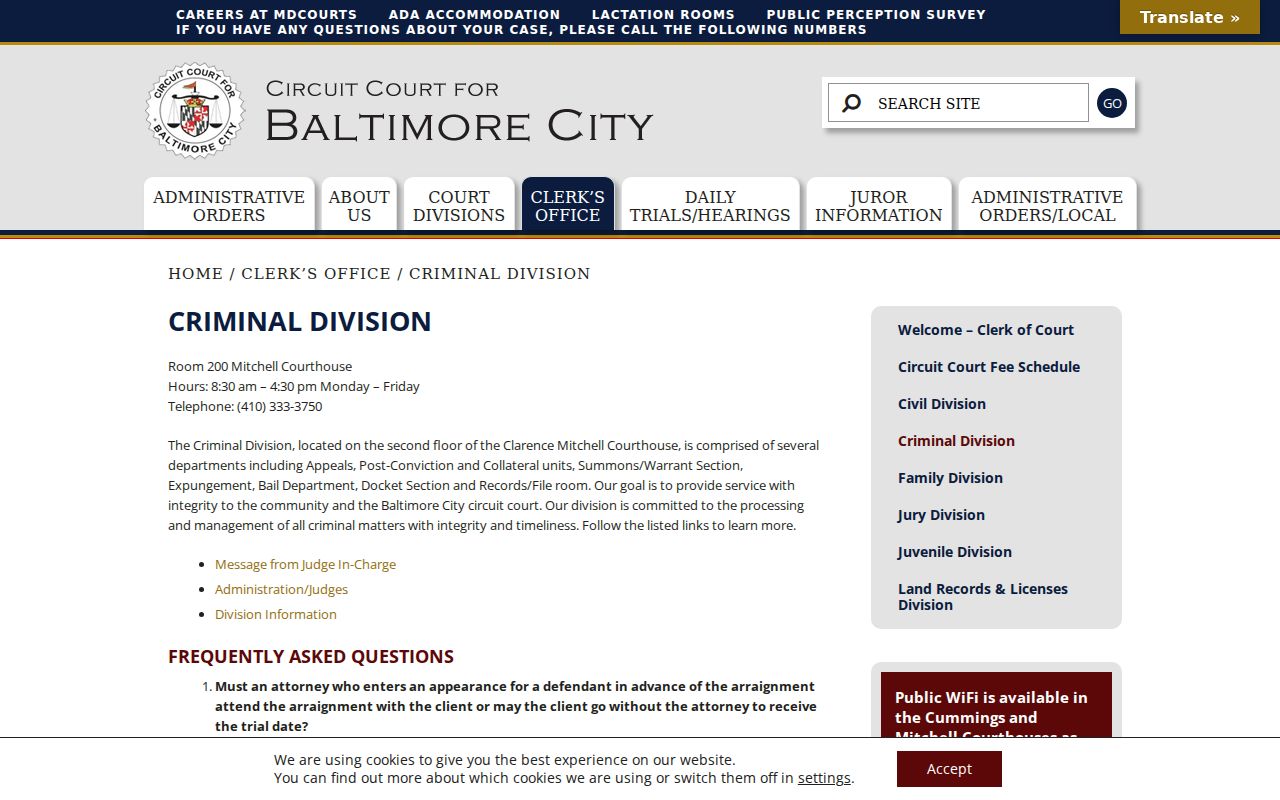
For a felony or serious criminal case, the local counter is the Criminal Division of the Circuit Court for Baltimore City. Its clerk's office runs a Summons/Warrant Section and a Bail Department from Room 200 in the Clarence M. Mitchell Courthouse. That office holds the complete circuit file, which the public index only summarizes. The clerk, not the sheriff, controls what happens next on a case in Baltimore City. A recall motion, a new hearing date, and a bond order all start there. The Circuit Court for Baltimore City, Criminal Division page describes those services.
Baltimore City Warrant Types
Maryland uses court-centered language, so most of what the public calls a Baltimore City warrant falls into a few categories. Each one carries its own issuing office and its own route to resolution.
| Warrant Type | How It Arises | Who Issues It |
|---|---|---|
| Arrest warrant | Probable cause plus a statutory condition is found | District judge or commissioner; circuit judge or clerk |
| Bench warrant | A required appearance or release condition is missed | The judge where the appearance was owed |
| Citation bench warrant | An unpaid prepayable citation and a missed trial, after five days | District judge handling the citation |
| Search warrant | Probable cause that evidence sits in a place or thing | District or circuit judge |
| Body attachment | A witness or party disobeys a subpoena or order | The issuing civil, family, or criminal court |
An unpaid ticket is the type readers misread most. A payable violation can bring a license notice from the Motor Vehicle Administration, while a bench warrant needs a court event in Baltimore City. The District Court traffic page lists the four official responses to a ticket.
Baltimore City Ordinance and Municipal Warrants
Baltimore City runs no separate municipal court, justice-of-the-peace court, or city warrant portal. The Judiciary directory lists a Circuit Court, a District Court, and an Orphans' Court for the city. That means a city ordinance case is heard in the District Court. Non-felony ordinance charges sit with the District Court under Courts Article 4-301. City enforcement still produces the citation. Under Baltimore City Code 71-2, a prepayable criminal citation must explain payment and trial options, and a missed trial can lead to a bench warrant or a contempt order. So a so-called Baltimore City warrant is really a District Court case.
Inside a Baltimore City Warrant Record
What the public sees in Baltimore City is a case summary with docket events, not a standalone warrant card. Maryland publishes no fixed warrant number format. Copy the case number the index returns.
| Case Number | Formats vary by court and year. Copy the returned number exactly instead of guessing one. |
|---|---|
| Court Level | District Court, District 1 or the Circuit Court for Baltimore City. This decides which clerk holds the file. |
| Charge | The offense as docketed, with a classification where one is public. |
| Warrant Event | A docket event such as FTA/Bench Warrant recording the warrant. |
| Bond | Amount and type when a bond event is entered. |
| Withheld Material | Sealed, juvenile, shielded, expunged, and certain arrest-warrant papers stay out of public view. |
The Baltimore City event history is written in codes. The Judiciary publishes a few examples worth knowing.
- DOCI
- Document issued in the case.
- CMIT
- Defendant committed to custody.
- RELS
- Defendant released.
- BOND
- A bond event with a date, amount, and type.
A Blank Baltimore Warrant Result Proves Nothing
A Baltimore City search that returns nothing is easy to read as clearance. It is not, and several ordinary situations produce an empty result on a live warrant:
- A warrant issued in the last day or two that the clerk has not entered
- A sealed indictment, or arrest-warrant papers that are not public
- A confidential juvenile record
- A case that was expunged, shielded, or sealed by order
- A minor traffic case that moved to history after 36 months
- A federal or out-of-state warrant, which never appears in the state index
Issuing and Serving Warrants in Baltimore City
A judge issues the warrant, and a law enforcement agency serves it. Only the court can change a warrant's status. The Baltimore City Sheriff's Office is the court's own law enforcement arm, and its public materials describe service of court documents from eviction orders to arrest warrants. Special Operations handles criminal warrants from the Circuit Court.
Baltimore City Sheriff's Office
100 N. Calvert Street, Room 104, Baltimore, MD 21202
General line: 410-396-1155
Temporary dispatch: 667-440-5934
| Matter | Who Issues | Who Serves |
|---|---|---|
| Circuit felony warrant | Circuit judge or clerk | Sheriff's Special Operations or another assigned agency |
| District misdemeanor or traffic warrant | District judge or commissioner | Baltimore Police or another Maryland agency |
| Violent-crime or fugitive case | The issuing court | Police task force, state team, or federal task force |
Where Baltimore City Warrant Cases Are Heard
Location matters in Baltimore City more than in most places. District Court services that once ran from East Fayette Street moved to 500 N. Calvert Street in October 2025, and older instructions still show the closed address. The Judiciary move notice controls which sites are current. The District 1 directory lists all four.
| Location | Address | Phone |
|---|---|---|
| Wabash | 5800 Wabash Avenue | 410-878-8000 |
| Hargrove | 700 E. Patapsco Avenue | 410-878-8300 |
| Eastside | 1400 E. North Avenue | 410-878-8500 |
| North Calvert | 500 N. Calvert Street | 410-878-8900 |
The location where a Baltimore City case was filed holds the file. A bench warrant question goes to that counter.
If You Have a Baltimore City Warrant
Finding a warrant on your own name is a starting point, not an emergency in Baltimore City. The path forward runs through the issuing court. It goes faster with a lawyer. A lawyer can ask about a recall, explain the arrest risk, and arrange a controlled appearance.
- Write down the case number, court level, and charge from the docket.
- Call the issuing clerk and ask whether the warrant is active and whether bond is set.
- Ask a Maryland attorney about a motion to recall or a new hearing date.
- Confirm the bond amount and accepted payment method before posting anything.
- Attend every new setting, because a missed date can produce another warrant.
Important: Talk to a lawyer before turning yourself in. An active warrant can lead to arrest at a traffic stop, and a planned appearance is safer than an unplanned one.
How Baltimore Warrant Payment Scams Work
The Baltimore City sheriff's office publishes a warning about callers who claim a warrant can be cleared for money. Someone spoofs a government number, says a warrant or a missed jury duty notice is pending, and asks for payment by phone to make it disappear. Two rules end the conversation. Courts and sheriffs do not demand payment by phone, and they do not ask for gift cards, money packs, or a mobile payment app transfer. No payment of any kind clears a warrant either. Only the issuing court can recall it. Hang up, then call the clerk or sheriff at a published number and ask about your own case.
Baltimore City Arrest Warrants and Central Booking
Anyone arrested in Baltimore City, or picked up on a Baltimore City warrant, goes to one door: the state's Central Booking and Intake Center at 300 E. Madison Street. The facility opened in 1995. It has served as the city's single intake point ever since. A District Court commissioner there reviews probable cause and decides whether to set bail. The District Court arrest and bail page lays out the bond options that follow: cash, property, a card payment, or a professional bail bondsperson. Posting bond secures an appearance. It does not dismiss the charge. For questions on the enforcement side, the Baltimore Police Department headquarters page lists the department's contact and district routing.
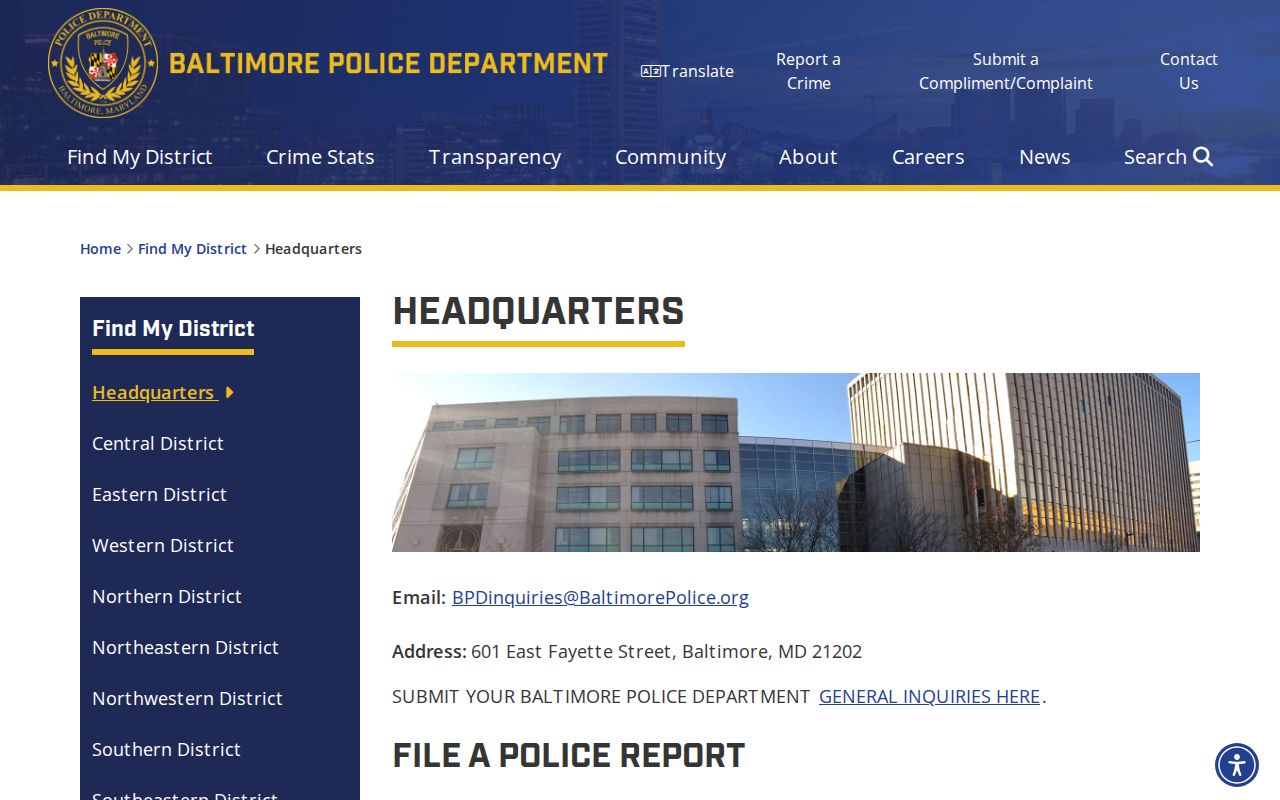
In Baltimore City, police headquarters handles public records requests, while the Warrant Apprehension Task Force enforces violent-crime warrants.
Baltimore City Warrant Records and Public Access
Maryland treats judicial records as open until a law says otherwise. That principle reaches the public index and the clerk's file alike. Some warrant material still stays closed. Papers tied to an arrest warrant, search warrant files sealed before execution, and juvenile records all sit outside public access. For agency-held records, send a written request to the agency that keeps them, which in Baltimore City usually means the clerk or the sheriff.
Key Rules:
Maryland Public Information Act - the state access law for agency records, with inspection at a reasonable time unless another law allows denial.
Access to Judicial Records - the Judiciary's summary of what stays closed, including confidential warrant material.
Courts Article 3-8A-27 - juvenile police and court records are confidential.
Put it in writing. A records request to a Baltimore City agency should name the record, the case number, the date range, and the format wanted. Agencies generally answer within 30 days, and the first two hours of search cost nothing.
The Numbers Behind Baltimore City Warrants
Baltimore City is an independent city. It serves as both the local jurisdiction and the court district. That gives it one Circuit Court, one District Court district, one intake center, and a sheriff's office with a warrant function. The numbers come from the Census Bureau's Baltimore City profile and the police department's 2026 mid-year report.
The arrest number is an enforcement result. It reflects work by the police Warrant Apprehension Task Force, up 146 over the same period a year earlier. It does not count open warrants, and Baltimore City publishes no such tally. The sheriff's 2026 term report mentions a violent-crime warrant backlog but gives no count either.
Baltimore City Warrants by City
This jurisdiction has just one incorporated city: itself. Baltimore City is an independent city, not part of Baltimore County. Municipalities in neighboring Baltimore County answer to a different set of courts. So a Baltimore City warrant search starts and ends within the city's own boundaries. The city-level page covers the Baltimore Police Department, the District Court location that hears ordinance and traffic cases, and the path a citation travels to the sheriff and the statewide index.
Baltimore City Warrant Records
585,708 residents (2020 Census) · Baltimore Police Department and Maryland District Court, District 1