
Baltimore City Arrest Warrants Explained
An arrest warrant is a written command. It orders a peace officer to take a named defendant into custody. In Baltimore City, as across Maryland, the document rides on a charge. A summons can compel an appearance, but only a warrant authorizes arrest. A bench warrant is different, arriving after a missed court date. Under Courts Article 2-607, a District Court commissioner reviews each charging application before issuing either one. A warrant goes out only on probable cause plus at least one listed condition. One example is a prior failure to respond to a summons already served. Another is a need for custody so the court can obtain jurisdiction.
How Probable Cause Becomes a Baltimore Warrant
The paperwork path is short and documented. An officer, a prosecutor, or a complainant supplies charging information. A commissioner or judge then tests it for probable cause and checks the statute's conditions. If the fit is there, the court issues a summons or an arrest warrant in Baltimore City. The charging document is attached and entered as the rules direct. Maryland Rule 4-212 governs issuance and service. It does not convert every complaint into a warrant. A circuit judge can also direct the clerk to issue one in a circuit case.
Inside a Baltimore City Arrest Warrant
The Baltimore City public interface gives a case summary and a docket. It stops there. No standalone warrant number, no issuing judge's name, no full affidavit, and no current service status appear. Those are the fields a reader can actually rely on.
| Case Number | The identifier the clerk uses for every later request. Copy it exactly as returned. |
|---|---|
| Court | District Court, District 1 or the Circuit Court for Baltimore City. |
| Party Fields | Name, date of birth, and party type when the record is public. |
| Charge | The offense as docketed, with a felony or misdemeanor classification where public. |
| Warrant Event | A docket line for the warrant or a document-issued entry such as DOCI. |
| Bond | Amount and type when a bond event is recorded after an initial appearance. |
| Restricted Material | Sealed indictment and arrest-warrant papers, plus juvenile records, stay out of public view. |
When Maryland Issues a Summons Instead
A charge in Maryland does not guarantee a warrant. The rules favor a summons wherever a Baltimore City court can compel an appearance without custody. The statute's warrant conditions are specific, not general.
| Point | Summons | Arrest Warrant |
|---|---|---|
| Effect | Directs an appearance in court | Authorizes custody |
| Typical setting | A charge that can proceed on a court date | A statutory condition is met or the court requires custody |
| Public record | A docket entry and case summary | A docket entry, with some warrant papers restricted |
Serving Arrest Warrants in Baltimore City
Who serves a Baltimore City warrant depends on the case, because service is law enforcement work rather than a clerk's task. The sheriff's office executes court documents, including arrest warrants, and its Special Operations unit handles criminal warrants from the Circuit Court. The police department investigates and obtains its own local warrants. Its Warrant Apprehension Task Force works violent-crime cases. State and federal partners join in on fugitive matters. Service can happen at a traffic stop, at a home, or through an organized operation. None of that operational detail reaches the public record. That is why no website can tell you whether a warrant has been worked yet.
Two Roles in Baltimore City Warrant Service
The sheriff and the police both serve Baltimore City warrants, but the work differs. The sheriff is the court's law enforcement arm, tied to court documents and circuit criminal warrants. Police bring their own cases and chase violent-crime fugitives through a dedicated task force. The Baltimore City Sheriff's Office service page details that court role and its document service.

The sheriff's own contact page for Baltimore City lists how to reach the office directly. See the Baltimore City Sheriff's Office contact page.
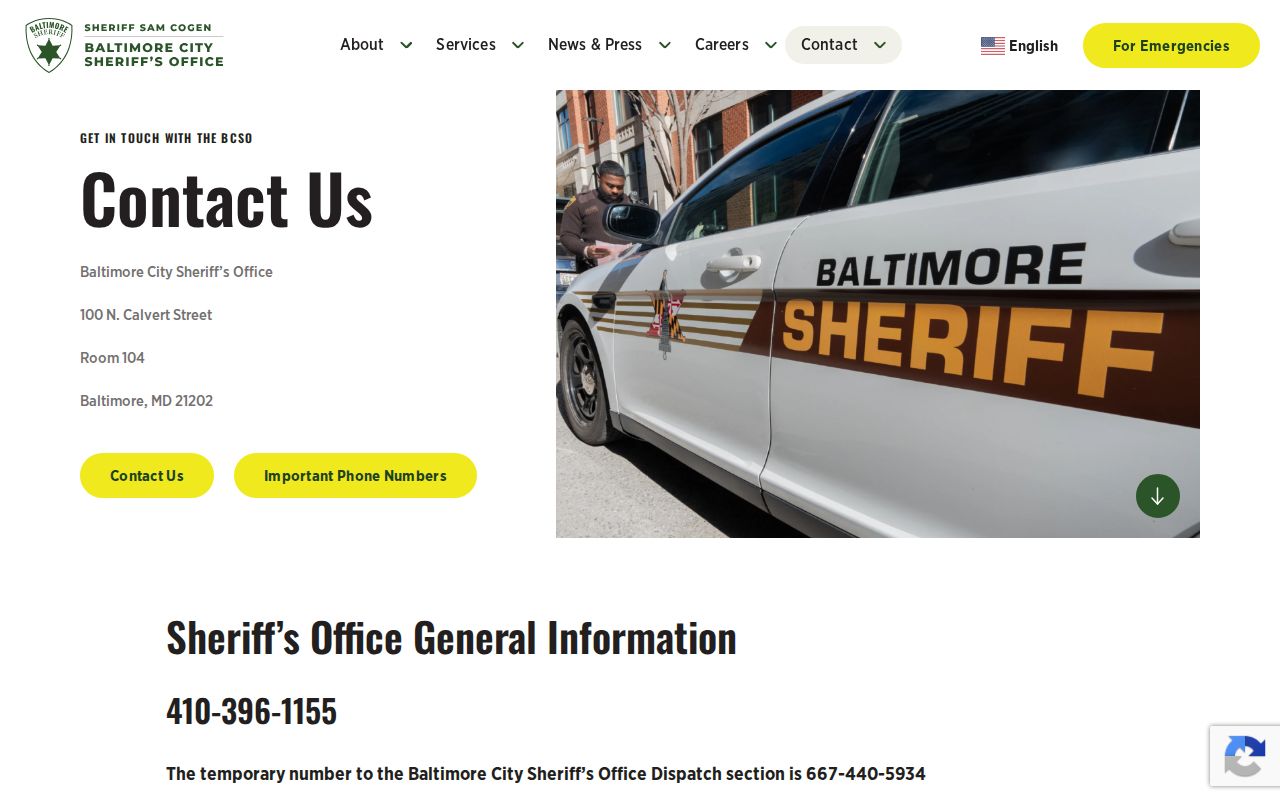
The Baltimore City sheriff's contact page lists the office address, the general line at 410-396-1155, and a temporary dispatch number.
Comparing Arrest, Summons, and Bench Warrants
The three share a courthouse and differ in what starts them.
| Point | Arrest Warrant | Summons | Bench Warrant |
|---|---|---|---|
| Trigger | Probable cause plus a statutory condition | A charge that can proceed on a court date | A missed appearance or violated condition |
| Custody authority | Yes | No | Yes |
| Who issues | Judge, commissioner, or clerk on direction | The court | The judge in the court where the appearance was owed |
Of the three, a bench warrant most often follows a missed date in a case already open in Baltimore City. It can follow either an arrest warrant or a summons.
If There Is an Arrest Warrant for You
A Baltimore City arrest warrant authorizes custody on contact. So the first move is a lawyer, not a courthouse walk-in. A Maryland defense attorney can call the issuing court and ask about a recall or a controlled appearance. The attorney can also explain the bond question and where a posting would happen if a judge sets one. The practical steps then run in a fixed order. Confirm the case with the clerk. Ask what the judge has ordered, arrange any appearance through counsel, confirm the bond amount and the accepted payment method, and keep the receipt and the order. Bond secures an appearance, and it does not dismiss the charge. Any Baltimore City recall still has to come from the issuing court.
Important: Do not turn yourself in without talking to a lawyer first. A planned appearance through counsel is safer than an unannounced visit to a police station or a courthouse.
If a missed date rather than a new charge produced the warrant, the bench warrant search page covers the Baltimore City recall path in more detail.
Central Booking After a Baltimore City Arrest
Everyone arrested in Baltimore City passes through the state's Baltimore Central Booking and Intake Center at 300 E. Madison Street. It is a processing location, not a records counter. Next, a District Court commissioner takes up probable cause, the charge, and bail. The District Court arrest and bail page lays out the bond types, which include cash, property, a card payment, and a professional bondsman. Public defender eligibility questions can be routed through 1-833-453-9799. The Central Booking and Intake Center page covers the facility itself.
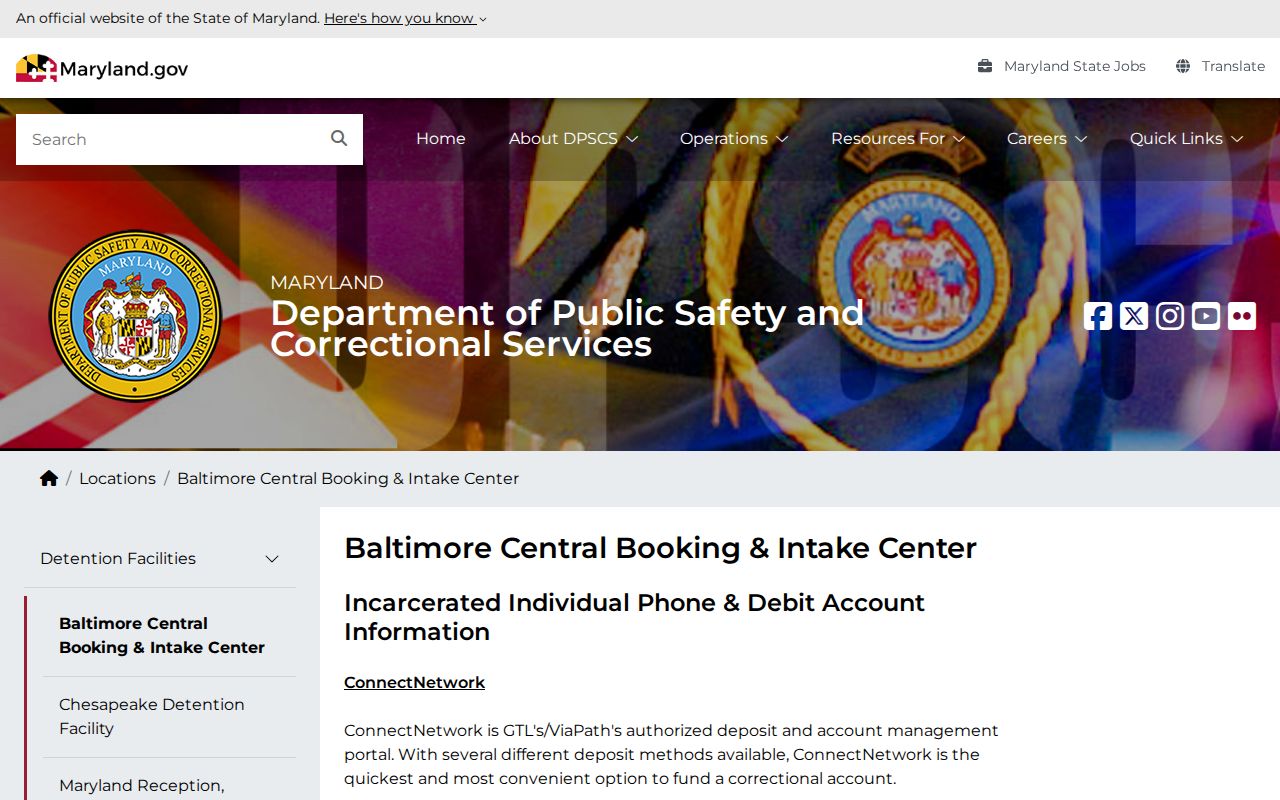
The state's Baltimore City booking page gives the facility address, contact information, and security rules. Check those before traveling there.
Bond Is a Release Tool, Not a Dismissal
A bond in Baltimore City only buys a court date. It settles nothing else. The outstanding warrant stays on the books until the case itself moves forward, and posting bail never resolves the underlying charge. Whoever puts up the money answers for the person's appearance too. Miss the date and Baltimore City can issue a new bench warrant while the cash or property is forfeit. Bail comes in several forms. A person, or someone acting for them, can post cash. Maryland property, approved by the court, also qualifies. So do intangible assets a clerk accepts, a card payment run through an independent processor, or a professional bondsman who charges a nonrefundable fee and may want collateral. Some defendants are held without bond entirely.
Restricted Arrest Warrant Papers in Baltimore
Not every paper tied to a Baltimore City arrest warrant is open to the public, and that is by design. Maryland's judicial access guidance treats certain warrant records as unavailable. Sealed search warrant papers and juvenile files fall under the same shield. A sealed indictment stays closed until the court grants access.
Key Rules:
Access to Judicial Records - the Judiciary's list of closed categories, including certain arrest-warrant material.
Criminal Procedure Article 1-203 - a judge may seal a search warrant affidavit for up to 30 days.
Ask the clerk directly. Give your name and case details, and the Baltimore City clerk can tell you what an identity check releases to you or your attorney.
Federal Baltimore Arrest Warrants Are Separate
Federal warrants are a different animal. Nothing from that side shows up in the Maryland case index. A federal judge or magistrate issues them, not a state court in Baltimore City. The U.S. District Court for the District of Maryland sits in Baltimore at the Edward A. Garmatz courthouse, and its dockets run on a separate system entirely. That system has its own access rules and its own fees, so a state-level warrant search will never surface this material. If a federal warrant is the worry, go through counsel and the federal court directly rather than a private lookup site. The U.S. Marshals Service district office serves federal process in the Baltimore area and works with local agencies on fugitive matters.