
Baltimore City Municipal Court Warrants
There is no municipal court here. The phrase "Baltimore City municipal court" turns up in plenty of searches, yet the office it names does not exist. The Maryland Judiciary directory lists three courts for Baltimore City: a Circuit Court, a District Court, and an Orphans' Court. Nothing called a municipal court appears anywhere on that list. So every city ordinance warrant is really a District Court warrant, issued in a District Court case. The file sits with a District Court clerk rather than a city agency. Anyone hunting for a city court clerk will come up empty. The right counter is the District Court location where the citation was filed. Call that location directly. Its number, not a city line, is the one that answers warrant questions.
City Citations and District Court Forms
City enforcement still writes its own tickets. Under Baltimore City Code 71-1, special enforcement officers may issue criminal citations that order a person to appear before the proper District Court part for a code violation. The prepayable version carries extra rules. Under 71-2, a prepayable criminal citation must spell out the payment and trial options, and skipping the trial can bring a bench warrant or a contempt order after a five-day wait. So the paperwork starts with the city while the case lives in state court. Anyone holding a citation that names a District Court part should treat it as a court matter from the first day. The deadline printed on the paper is a court deadline. The full text sits in the Baltimore City Code, prepayable criminal citation rule.
Cities With Municipal Courts in Baltimore City
One city sits here, and it runs no municipal court. Baltimore City is an independent city, separate from Baltimore County, and its ordinance matters are heard by the District Court. The table shows where a city citation actually lands.
| City | Municipal Court | Warrant Types | Where to Call |
|---|---|---|---|
| Baltimore City | None; city ordinance matters are heard in District Court, District 1 | Traffic and ordinance citations, failure to appear | District Court location where the case was filed |
Neighbors in a Baltimore County municipality live in a different county and a different court system. A warrant search run from a Baltimore City page will not find their case.
BPD Officers and City Code Citations
Citations in Baltimore City come from more than one source. Patrol officers write traffic and criminal citations. Special enforcement officers issue citations for code violations that direct the recipient to a District Court part. Enforcement is local, and the case is state court. The police department publishes a general contact route and a public information request process, not a citation lookup. Anyone who needs the case record goes to the court. Anyone who needs the police report or the enforcement record files a written request with the department. For non-emergency questions, the Baltimore Police Department contact page explains how inquiries are routed.
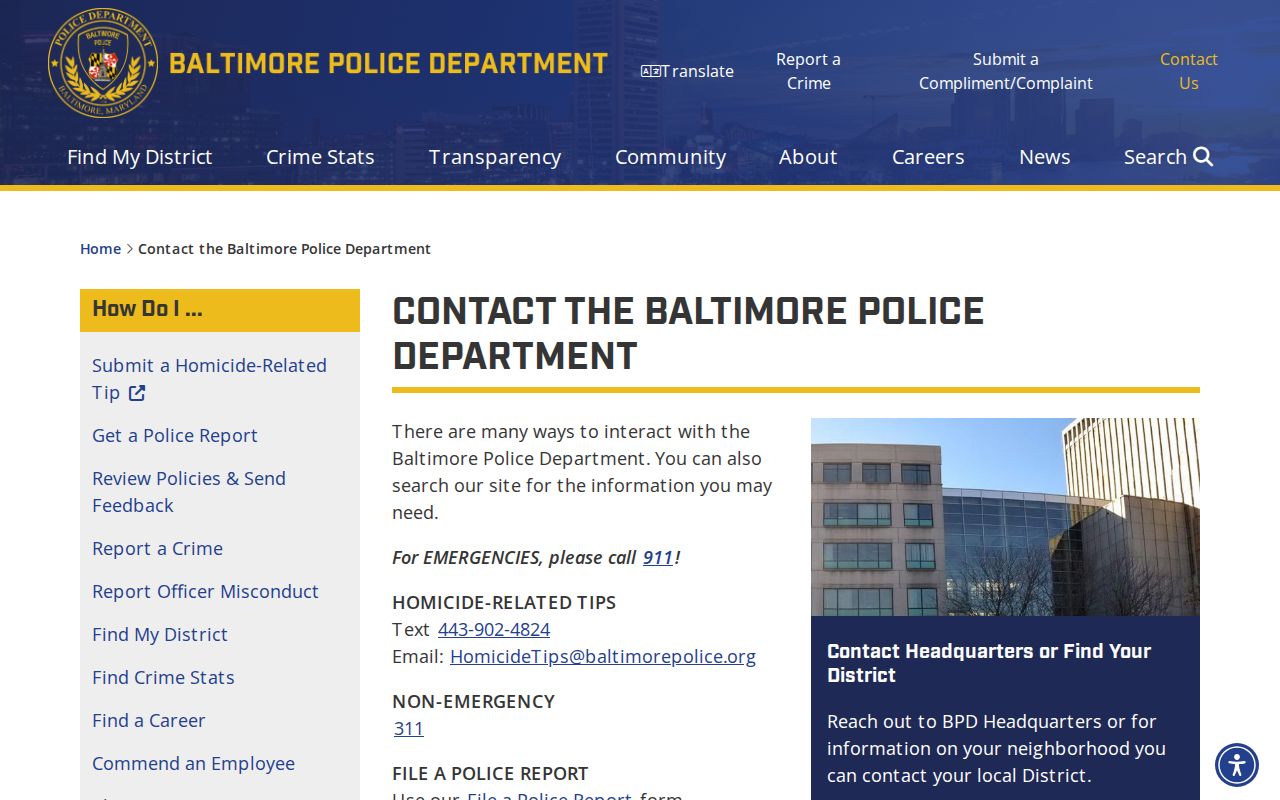
That page lays out how non-emergency questions reach the right unit. It is the sensible first stop before asking about the enforcement side of a Baltimore City citation.
Checking a Municipal Court Warrant
Every channel works for a city citation. The index shows the docket. The clerk confirms it, the sheriff explains service, and a records request brings a copy. Only the District Court record settles whether a Baltimore City warrant is active.
- Open Maryland Judiciary Case Search and accept the terms.
- Enter the citation or case number, or search by exact name with a date of birth.
- Set Case Type to Traffic or the relevant category and the court system to District Court only.
- Read the event history for a failure to appear or bench warrant entry, and note the case number.
- Call the District Court clerk where the case was filed to confirm the warrant and the next step.
- Ask the sheriff about serving only if the case is a Circuit Court matter.
Civil Citations and Criminal Citations Differ
Not every city citation is a criminal matter, and the difference shapes what a warrant means. Under Courts Article 4-301, the District Court holds exclusive original jurisdiction over vehicle law violations and non-felony municipal ordinance crimes. A civil city penalty matter follows a parallel path instead. The court can share jurisdiction over some civil ordinance proceedings in Baltimore City.
| Point | Criminal Citation | Civil Citation |
|---|---|---|
| What is charged | A non-felony offense under city or state law | A civil penalty for a code violation |
| Failure to respond | Can lead to a bench warrant or a show-cause order | Typically enforced through the civil penalty process |
| Where it is heard | District Court, District 1 | District Court or the city agency named on the citation |
The citation itself names the track, so read the paper before assuming a Baltimore City arrest order is even possible.
Inside a Municipal Court Warrant
The record looks like any other District Court docket, because the case is one. In Baltimore City, the city citation supplies the charging document. The court supplies every event after that.
| Citation or Case Number | Searched in the Case Number field and reused on every request. |
|---|---|
| Court | District Court, District 1, at the location where the case was filed. |
| Charging Document | The city or traffic citation, with its payable or must-appear designation. |
| Failure to Appear | A docket entry such as FTA/Bench Warrant when one is recorded. |
| Fine or Penalty | The amount stated on the citation or set by the court. |
| Resolution Event | A payment, new date, recall, or disposition as the court enters it. |
Finding the Right District Court Location
A city citation is heard at the District Court location where it was filed. Baltimore City court geography changed in October 2025. Services once housed on East Fayette Street moved to 500 N. Calvert Street. An older citation or printed direction may still name the closed location. The current District Court locations are Wabash, Hargrove, Eastside, and North Calvert. The clerk at the filing location holds the warrant record. Trust the court's own move notice for the right address today.
Note: A citation that names a District Court part tells you the court level, not the building, so confirm the address before traveling.
How to Resolve a Municipal Court Warrant
Resolving a Baltimore City municipal court warrant starts with the citation itself. If it is still payable, four official paths exist: pay it, ask for a payment plan where allowed, request a waiver hearing, or request a trial. Miss the hearing instead? Put the request for a new date in writing and send it to the court where the original date was set. The clerk can tell you whether the judge wants anything else first, such as a recall motion, a bond, or an appearance before the bench warrant comes off the docket. Only a judge can recall it, so no other office in Baltimore City clears that warrant for you. If bond is required, it gets posted through an approved method, never paid to a city agency.
Caution: Paying a fine after a bench warrant is entered does not clear the arrest order. Ask the clerk for the recall path before making a payment.
No Baltimore City Citation Amnesty Program
Baltimore City runs no amnesty week, no safe-surrender window, and no citation forgiveness program. A historic child-support reconciliation event in Baltimore let some parents resolve support warrants at the courthouse without arrest. That program is old and covered one kind of case, so it is not a current amnesty for citations. Watch for scams too. Anyone who calls offering to clear a city citation for a fee is a scammer. Courts do not collect warrant payments by phone, and no payment clears a warrant without a judge's order.
Key Point: The real path is the District Court clerk, the official payment options, and a judge's recall. Nothing else clears a city citation warrant.
Case Search Is the City Citation Index
Here is the most useful fact on this page for a confused reader: Baltimore City has no citation database and no municipal roster to search. City ordinance and traffic cases live in District Court, so the statewide case index is the public index for them, and the police department and other city agencies publish no citation lists. A search that finds nothing on a city website has not failed. That record was never there. The court index and the District Court clerk are the two doors to the case, and either one can tell you what exists.