
Baltimore City Bench Warrants Explained
Maryland's Judiciary keeps the definition plain. A bench warrant is an arrest order a judge signs after a defendant fails to appear as required. In Baltimore City the usual triggers are a missed trial or hearing, a broken release or program condition, and noncompliance with a court order. Whatever the cause, the result is an arrest order. Nothing softer. This state does not use the capias pro fine that some courts elsewhere use to collect fines, so that term will not appear in Baltimore City paperwork. The local vocabulary stays simple. It is a bench warrant or an arrest warrant.
The Five-Day Rule for Missed Baltimore Citations
One Baltimore rule is genuinely local. Under Baltimore City Code 71-2, a prepayable criminal citation must spell out the payment and trial options. Skip both and you risk a bench warrant for arrest or a contempt show-cause order. The same provision builds in a pause. No bench warrant may issue until five days after the scheduled trial date. That gap matters if you missed a citation trial last week. The case can be moving toward a warrant even though none exists yet.
How Baltimore City Bench Warrants Are Issued
Issuance starts with a missed event on the docket. The court records the failure to appear. A judge then reviews the case and chooses among issuing a bench warrant, setting a new date, or taking some other step. Once issued, the warrant stays under that judge's control. A District Court administrative regulation says a bench warrant or trial failure-to-appear warrant may be recalled by a judge at any time. Where the paperwork lives depends on the court. In Baltimore City circuit cases, the Criminal Division keeps the file along with its Summons/Warrant Section and Bail Department. A District Court case stays at the location where it was filed or heard. Either way, the warrant shows up as a docket entry. It is not a separate public document you can pull.
Why Baltimore City Bench Warrants Split Two Ways
Many people expect one bench warrant office and find two. Baltimore City has no municipal court or justice of the peace. The lower-court lane is the District Court, District 1, which hears traffic, misdemeanor, and city ordinance matters. Felonies belong to the Circuit Court for Baltimore City. That split shapes everything practical. It decides which clerk you call, which judge can recall the warrant, and where a new date gets set. A bench warrant off a city ordinance citation and one off a circuit felony indictment sit with different clerks in different buildings. Both are still Baltimore City warrants.
Bench Warrants and Arrest Warrants Compared
Both order an arrest in Baltimore City. They differ in origin and in what moves each one forward.
| Point | Bench Warrant | Arrest Warrant |
|---|---|---|
| What triggers it | A missed appearance or a violated condition | A charging document supported by probable cause |
| Who issues it | The judge in the court where the appearance was owed | A judge, a commissioner, or a clerk on judicial direction |
| What it means | An arrest order in a case already open | An arrest order tied to a charge |
| Usual first fix | A new date, a recall, or a bond set by the judge | Counsel, a controlled appearance, and bond where set |
In Baltimore City, a bench warrant can also follow an arrest warrant when a defendant later misses a setting.
After a Missed Baltimore City Court Date
The first hours after a missed date offer the easiest fix in Baltimore City. Start with a phone call, not a courthouse visit.
- Search the case index for the case and note whether a warrant entry has appeared.
- Call the clerk at the location where the case was set and ask whether the warrant is active.
- Ask whether the court wants a written request for a new date, a motion, or an appearance.
- Ask a lawyer to handle the request when a warrant is already active.
- Confirm the new date in the docket once the court enters it.
Resolving a Baltimore City Bench Warrant
Resolution in Baltimore City has three parts. The judge must recall or satisfy the warrant. Any bond the judge sets must be posted through an approved method. And the underlying case has to move forward on a new date. A bond alone does none of the rest, and a recall does not dismiss the charge. A lawyer can ask the court for a recall, arrange a controlled appearance, and explain the arrest risk before you act. The clerk plays a smaller but useful role. The clerk can tell you what the judge has already ordered and where a bond would be posted.
Caution: Do not assume that showing up at a courthouse clears a bench warrant. Until a judge recalls it, the warrant authorizes arrest, and the safest route is a planned appearance through counsel.
Recall Is Not Dismissal in Baltimore City
Two words get used as if they match. They do not. A recall in Baltimore City withdraws the arrest order and puts the case back on a calendar. A dismissal ends the charge itself. A judge can recall a bench warrant on a case that is very much alive, and the underlying offense keeps going after the warrant comes off. A quash motion is different again. It asks the court to set a warrant or order aside, and the procedure runs through the issuing court. Neither step happens automatically after a payment, and neither can be finished from a website.
Note: After a recall, check the docket for the next setting and keep the written order or receipt, since a warrant can reappear if a later date is missed.
Finding the Court That Issued the Warrant
The docket names the court, and that name decides which counter to call in Baltimore City. Circuit matters go to the Criminal Division at 100 N. Calvert Street. The Summons/Warrant Section sits in Room 200, and the main line is 410-333-3750. District matters stay where the case was filed or heard. The Circuit Court for Baltimore City directory lists the court's own offices and contacts.
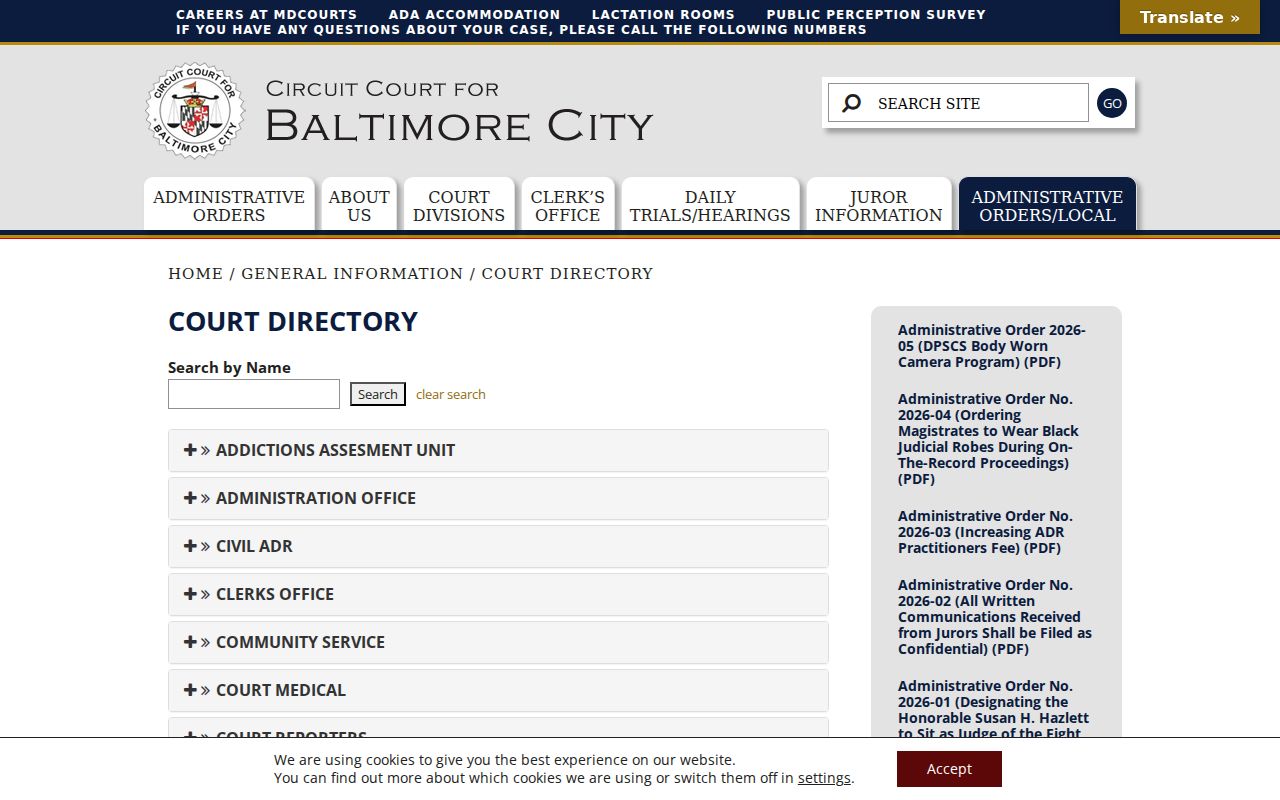
Need to know which Baltimore City office holds the criminal file? The directory answers that. District Court criminal filings are handled at Wabash, Hargrove, Eastside, and North Calvert, the site that absorbed services moved from East Fayette in October 2025.
The 500 North Calvert Commissioner Station
Baltimore City runs one centralized commissioner station on North Calvert, open around the clock every day of the week. This is where charging applications come in and where a commissioner first weighs probable cause. It is not a warrant clearing window. Nobody walks in there to wipe out an outstanding warrant. Show up with an active bench warrant and you can be arrested on the spot, since the warrant itself authorizes it. The safer move is a planned appearance with the issuing court, arranged through a lawyer.
Probation and Program Bench Warrants
Not every bench warrant begins with a missed trial. A violation of probation can trigger one. So can a failed drug or treatment program condition, or any failure to finish a court-ordered requirement. District Court administrative material states that the sentencing judge issues a probation violation warrant where practicable, and the same regulation confirms a judge may recall a warrant at any time. Those cases often sit on a specialized docket in Baltimore City, so the clerk may need the case number to route you to the right department. Do not try to negotiate a warrant through the probation office or a program provider. Only the judge can resolve it.
The Baltimore City Jury Duty Warrant Scam
The jury duty scam is one of the oldest phone tricks still going, and Maryland courts publish a warning about it. A caller claims a warrant went out because you missed jury duty, then demands payment to clear it. The caller often stays on the line to keep you moving. No court or sheriff collects a warrant payment by phone. None accepts gift cards, money packs, or a payment app transfer. Baltimore City residents can hang up on that call.
Key Point: Hang up and call the court at a number you looked up yourself. The Circuit Court main line is 410-333-3722, and the Criminal Division is 410-333-3750.